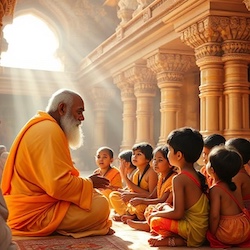
Welcome to Sanskrit One!
The aim of this website is to provide comprehensive resources for learning Sanskrit, from the basics of the language to the deeper study of classical literature and holy scriptures. Whether you are a beginner learning the alphabet and grammar, or an advanced student exploring ancient texts, this website is designed to support your journey.Here are some of the resources this site provides:
- Stories in Sanskrit with English translations, vocabulary and quizzes
- Vocabulary lists and picture dictionaries
- Sentences and conversations
- Grammar lessons
- Vibhakti tables with chanting and quizzes
- Dhatu tables with chanting and quizzes
- Scriptures and philosophical texts
- Subhashitams with English translations
- Tutorials for Samskrita Bharati and CBSE courses
All the lessons on this website assume that you already know how to read Devanagari.
In some places, we use English script for Sanskrit words (e.g. Pāṇini). When that happens we use IAST. To learn more about IAST, click here.
Your feedback is very important to us and will help us improve this website. Click here to give us your feedback.
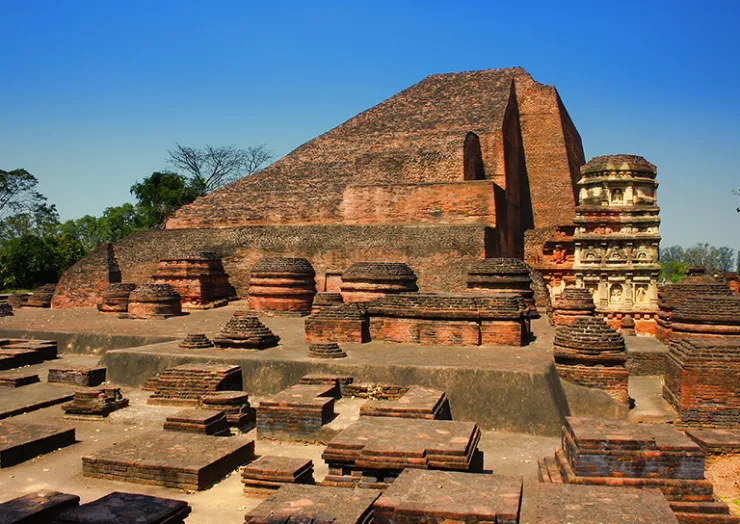
A Brief History of Sanskrit
Sanskrit is one of the oldest and most revered languages in human history. It originated in the Indian subcontinent and has played a central role in the development of literature, science, religion, and philosophy in South Asia for over three millennia.Origins and Vedic Sanskrit
The earliest form of Sanskrit is Vedic Sanskrit, which emerged around 1500 BCE and is preserved in the Rigveda, one of the oldest known texts in any Indo-European language. Vedic Sanskrit was primarily an oral tradition used in hymns, rituals, and religious ceremonies of early Hinduism. The language was poetic, rich in metaphor, and highly structured, reflecting both the spiritual and intellectual culture of the time.Pāṇini and Classical Sanskrit
Roughly around the 6th to 4th century BCE, the great grammarian Pāṇini systematized Sanskrit into what is now known as Classical Sanskrit. His work, the Aṣṭādhyāyī, is a highly sophisticated and comprehensive grammar consisting of 4000+ rules. It not only defined the structure of the language but also influenced modern linguistics. Classical Sanskrit became the standardized form for scholarly and literary use and remained remarkably consistent for over two thousand years.Sanskrit as a Literary and Scholarly Language
For centuries, Sanskrit was the medium of high culture, used in philosophy, mathematics, astronomy, medicine (Āyurveda), law, poetry, and drama. Works like the Upaniṣads, Mahābhārata, Rāmāyaṇa, and the Purāṇas explored metaphysics, ethics, cosmology, and more. Sanskrit was also used in Jain and Buddhist texts and played a vital role in the spread of Indian thought throughout Asia.Continuity and Influence
Though vernacular languages eventually replaced Sanskrit in daily life, it remained a language of learning and ritual. Many modern Indian languages, including Hindi, Marathi, Bengali, and Nepali, draw heavily from Sanskrit in vocabulary. Sanskrit also influenced languages beyond India, such as Tibetan, Khmer, and even Old Javanese.Modern Times and Revival
Today, Sanskrit is still used in Hindu rituals and is taught in schools and universities across India and around the world. There are even small communities where Sanskrit is spoken conversationally. The language has also attracted global interest among scholars, yoga practitioners, linguists, and spiritual seekers who are drawn to its precision, beauty, and cultural depth.Sanskrit stands not just as a relic of the past, but as a living bridge to India’s rich intellectual and spiritual heritage.